
Researchers from Sheffield Hallam University (SHU) have developed a patented technique that significantly improves the penetration and consolidation performance of nanolime on fine-grained limestone, a longstanding challenge in heritage conservation. Cliveden Conservation will give specifiers a first look at the new Nano Electro Application Technique (NEAT) at its Heritage Lime Training Day for Specifiers on 17th September 2026 at Reading Abbey Ruins.
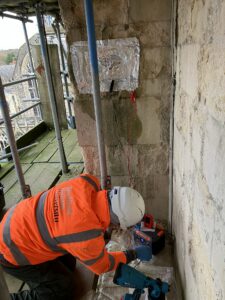
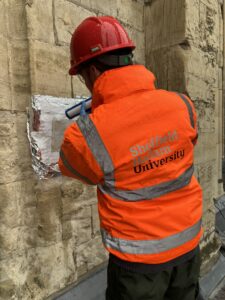
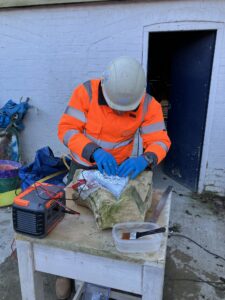
The training day covers the full lime cycle, material specification, mixing and application, with hands on pointing and consolidation practice, and will now include an introduction to NEAT alongside a practical walkthrough of the conditioning, application and decommissioning process.
Solving a known problem in stone conservation
Fine-grained limestone, found in many of the UK’s most iconic heritage buildings, is typically difficult to consolidate using existing nanolime application methods such as brushing and spraying. Multi-coat treatments are painstaking and can still fail to achieve effective in-depth consolidation, sometimes leading to blooming caused by nanolime building up on the treated surface. Alcoholic nanolime dispersions already on the market also struggle to penetrate deeply into dense, fine-grained substrates.
NEAT, developed in SHU’s laboratories, allows alcoholic nanolime to migrate deeper into deteriorated limestone without compromising its visual or historic integrity. The technique works by applying a direct electric current, generated by a portable power supply, to drive charged nanolime particles through the conductive substrate (i.e. limestone), a process known as electroosmosis. Tests showed that a deeper and more homogeneous penetration as well as a higher consolidation efficiency were achieved when limestone samples were consolidated with alcoholic nanolime mixed in a conductive aqueous gel applied with NEAT.
The researchers from SHU received funding from UK Research Innovation to trial NEAT on different sites in the UK and worldwide during a proof-of-concept project, to assess practicality, limitations, and performance of the technique.
About the Heritage Lime Training Day
The Heritage Lime Training Day for Specifiers takes place on 17th September 2026 at Reading Abbey Ruins.