
Cliveden Conservation is pleased to announce that the reinstatement of the South Front portico statues at Stowe House is complete. The copies of the seated figures of Cybele and Juno, which were created by Cliveden Conservation in collaboration with Stowe House Preservation Trust and sculptor Sam Steel, are now back in their original niches for the first time since they were sold at the historic 1848 Stowe Sale.
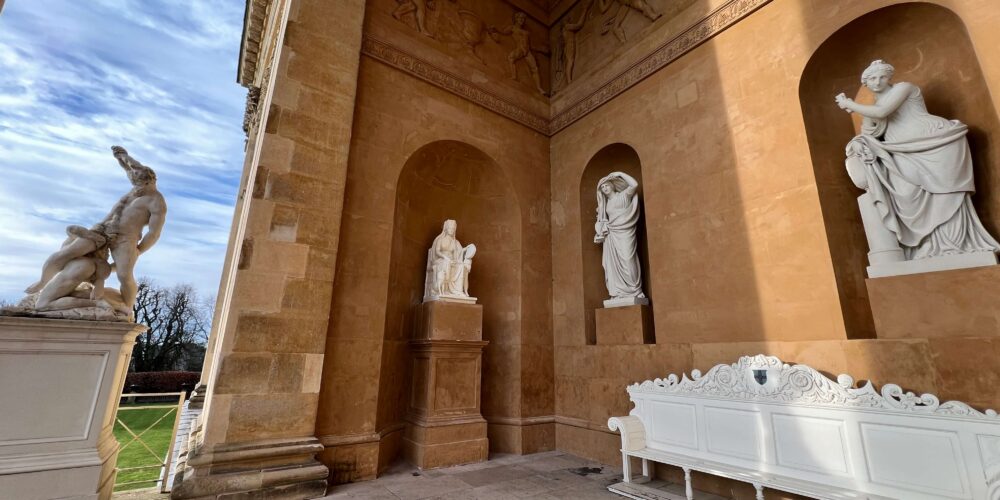
The installation marks a significant milestone in the Trust’s decades-long mission to restore Stowe House to its former architectural splendour.
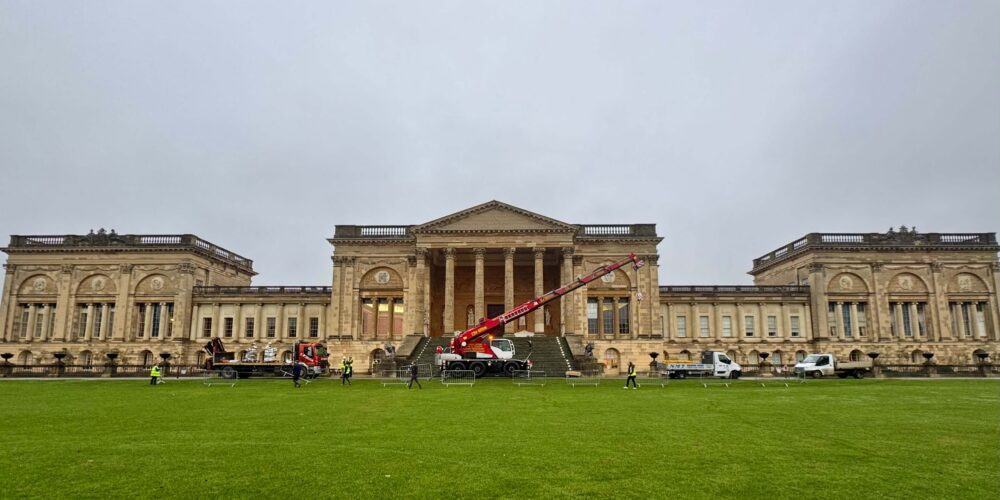
A specialist crane – one of only two of its type in the UK – was brought across the parkland to lift the newly cast statues, each weighing around 700kg, onto the portico. The pieces were then hoisted onto a scaffold tower and slid into place in their historic niches.
Anna McEvoy – Co-Director & House Custodian
“Seeing Cybele and Juno arrive has been deeply moving for everyone involved. It brings an architectural harmony back to the South Front that the building has been missing for almost two centuries.”
Recreating Two Lost Masterpieces
The original Cybele – a Roman sculpture dating from around AD 50 – is now housed at the Getty Museum, Los Angeles. Juno’s whereabouts remain unknown. In 2019, the Getty Museum generously undertook 3D scanning of the original Cybele and provided a digital model to the Trust. This scan became the foundation for the reconstructed Cybele, and ultimately, for a new interpretation of Juno.
Because seated Roman statues of female figures are extremely rare, and surviving depictions of Juno often recline too deeply for Stowe’s shallow niches, Stowe House Preservation Trust recognised that a direct copy was not possible. To develop a historically informed solution for Juno, the Trust commissioned Cliveden Conservation, who enlisted sculptor Sam Steel to design a new statue using a research-led, hybrid approach.
René Rice, Project Development for Cliveden Conservation, explains:
“‘The scaled 3D print was used as a maquette by our sculptor Sam Steel to model in clay a full-size clay reconstruction, reintroducing lost elements such as the nose, left hand and tympanum. A mould was taken from the clay using silicone rubber and the finished statue was cast in a ‘stone’ concrete mix. When the moulding of Cybele was complete, the clay version of Cybele was adapted with changes of pose and drapery to become the seated figure of Juno, which was also moulded and cast.”
During reconstruction, Cybele’s attributes were revisited, including her tower crown (protector of cities), lion (power over wild animals), cornucopia (agriculture and fertility) and rudder (control). Historic depictions also show her holding a tympanum (a hand-drum). To reflect this detail, the reconstructed hand was positioned across the top of the cornucopia and rudder.
How Cybele was transformed into Juno.
- Altering the pose to a gentler, slightly reclining form
- Reworking the top drapery
- Removing the lion
- Adding a peacock, symbol of Juno’s divine authority
- Introducing a head modelled from a 3D scan used for the recent North Hall bust project, derived from the celebrated Roman Juno Ludovisi
René Rice concludes:
“It was an honour to be asked by Stowe House Preservation Trust to recreate Cybele and Juno, and finally install them on their plinths on the South Front Portico. This was another momentous occasion in the ongoing restoration of Stowe House and we are so proud to be involved in this excellent project.”
For more information about the restoration project at Stowe House please visit: https://www.stowehouse.org/about-stowe-house/restoration/